Well Traveled Wrap
By Beth Bradley

When you're packing for a trip, versatility and simplicity in your clothing choices
are key. Take away the guesswork with this reversible knit wrap dress. It's two
dresses in one, so you'll save precious suitcase space. The wrap style is flattering
and classic, and there are endless ways to dress it up or down. The matte jersey
fabric is incredibly forgiving, comfortable and never needs pressing, so the wrap
dress will soon become your favorite travel companion.
What You'll Need
- Wrap – style dress pattern appropriate for moderate stretch knits (such as Butterick 5030)
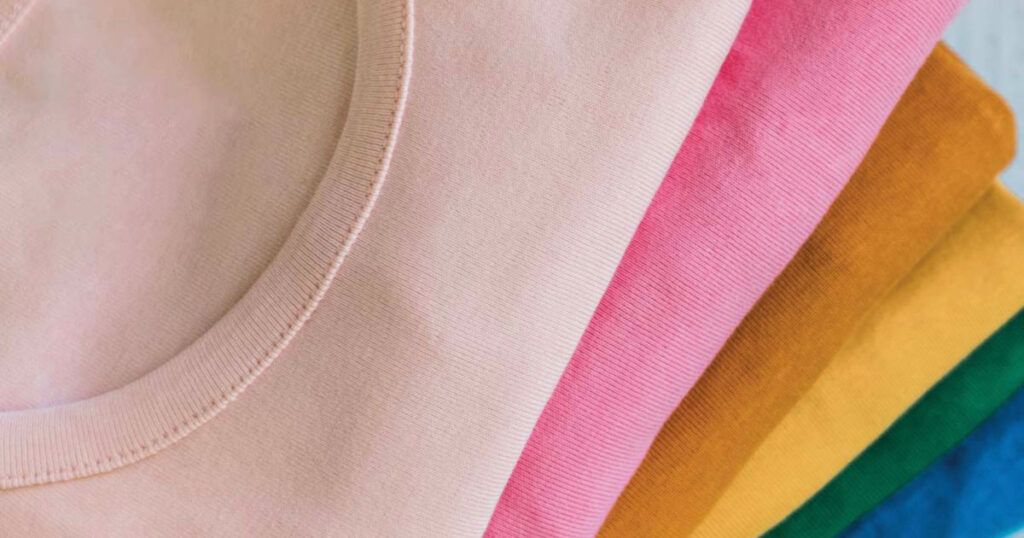
- 7 Matte jersey fabric in two contrasting or coordinating colors (yardage as indicated on the pattern envelope)
- ¼ yard of knit interfacing
- 75/11 sewing machine needle
- Matching polyester thread
- 4 sets of size 3 hooks and eyes
- ½ yard of ¼ " – wide clear elastic
Knit Wit
Knit fabric tends to have a mind of
its own, especially those knits with a
very drapy hand, such as matte jersey
and slinky. Follow these tips to show
slippery knit fabrics who's boss. (Also
refer to "Sandra's Solutions" by
Sandra Betzina on page 30 for
additional advice.)
Be sure that the pattern you've selected
is designed for knits rather than
wovens. Some pattern envelopes are
printed with a knit stretch gauge, so
you can check in advance if the fabric
will be compatible with the pattern. If
the fabric has less than the suggested
amount of stretch, add more ease to
the pattern.

Prewash the fabric according to the
instructions on the fabric bolt, or
according to how you plan to care for
the finished garment, to eliminate any
shrinkage before sewing.
For maximum control when cutting,
use the sharpest dressmaker's shears or
rotary cutter you can find. Use very
sharp pins, such as silk pins, and
weights to hold the fabric layers in
place while cutting.
Use a size 75/11 sewing machine needle
when sewing on lightweight knits.
Use 100% polyester thread with synthetic
knits. Polyester thread provides extra
strength and give when the seams are
stretched during wearing.
If the pattern requires interfacing, use an
interfacing that's appropriate to use
with knits, such as lightweight 100%
polyester knit fusible interfacing, in
order to retain the fabric's stretch and
drapability. Use interfacing in the color
that blends most easily with your fabric
color, as lightweight knits can be somewhat
sheer.
To stabilize necklines, shoulder seams
and armholes, use ¼" – wide clear elastic
sewn into the seams rather than woven
tape. Stretch the clear elastic a few
times before measuring, cutting and
sewing it.
The right and wrong sides of solid color
knit fabric can look virtually identical.
To keep from mixing up the fabric
sides during construction, mark each
pattern piece wrong side with a "W"
in tailor's chalk immediately after
cutting it out.
Test the various methods for sewing
construction seams in knit garments
before you begin sewing the garment.
One option is to use a very narrow
zigzag stitch to accommodate the
fabric's stretch. Another possibility is
to lengthen a straight stitch to 3 mm
and stretch the fabric gently as you sew.
Some machines also come equipped
with special knit or tricot stitches that
will stretch along with the fabric.
Test–sew on fabric scraps to determine
what stitch and tension works best on
your fabric.

Serge–finish seam edges or leave them
unfinished, as most knit fabrics don't
ravel easily. Serge–finish and topstitch
the hem, or use a coverstitch or doubleneedle
stitch. Before hemming, fuse a
very narrow strip of fusible knit interfacing
along the fabric lower edge to
add stability and avoid a wavy effect.
Cutting & Construction
From both fabrics, cut out the bodice,
skirt and sash pattern pieces according
to the pattern guidesheet. Set aside one
set of dress pattern pieces.
Using a hand basting stitch, trace the
front and back bodice darts (1).
Carefully pin the darts closed.
Stitch each dart from the fabric lower
edge to the dart point, following the
basted lines. Leave long thread tails at
the dart points. Remove the basting
stitches. Tie a double knot at each
dart point.
Trim the front bodice darts excess to 5/8
". Press the front darts toward the
center front.
Staystitch the front and back bodice
pieces at each shoulder line 3/8" from
the fabric upper edge.
Cut two pieces of clear elastic each the
same length as the shoulder seam.
Position each clear elastic length on the
bodice wrong side at the shoulder
seams. Right sides facing, stitch the
bodice front and back pieces together
at the shoulder line, stitching through
the clear elastic. Use a Teflon foot to
avoid sticking.
Right sides facing, stitch the bodice side
seams. Staystitch around the bodice
neckline for 4" down each bodice
front neckline edge (2). Staystitch
around the armholes.
Right sides facing, stitch the skirt front
and back together.
Cut two 1" – wide strips of knit interfacing
the same length as the skirt front
seam. Fuse the interfacing along the
skirt front edges for stability.
Staystitch the skirt at the waistline.
Right sides facing, stitch the dress
bodice to the skirt at the waist, matching
the notches and side seams. Press
open the waist – seam allowance, then
press toward the skirt.
Construct the dress sash according to
the pattern guidesheet.
Let the dress hang overnight. Sergefinish
the lower edge and sew
a ¼" hem. Or leave the lower
edge unfinished.
Construct the second dress and sash
from the other set of pattern pieces
according to the previous instructions,
but don't interface the front edges.
Right sides facing, pin the two dresses
along the front neckline and skirt seams.
Stitch the two dresses together (3).
Press open the neckline and skirt seams.
Trim the seam allowance to ¼". Turn
the dress right side out.
Steam the neckline and skirt seams to
shrink out any stretching that occurred
during sewing.
On the dress right side, turn under the
armhole raw edges; pin. Slipstitch the
armhole seams closed.

Try on the dress and pin – mark the
hook–and–eye placement at the waistline
on both sides of the dress. The
placement should fall near the bodice
front waist darts, but may vary slightly
based on your bust size and waist height.
Hand sew the hooks at each front edge
bodice/skirt intersection, and sew the
eyes at the pin marks (4). Sew eyes on
both sides so that the dress can be
worn on either fabric side.
Mix and match the two sashes with the
two dress sides each time you wear it. |